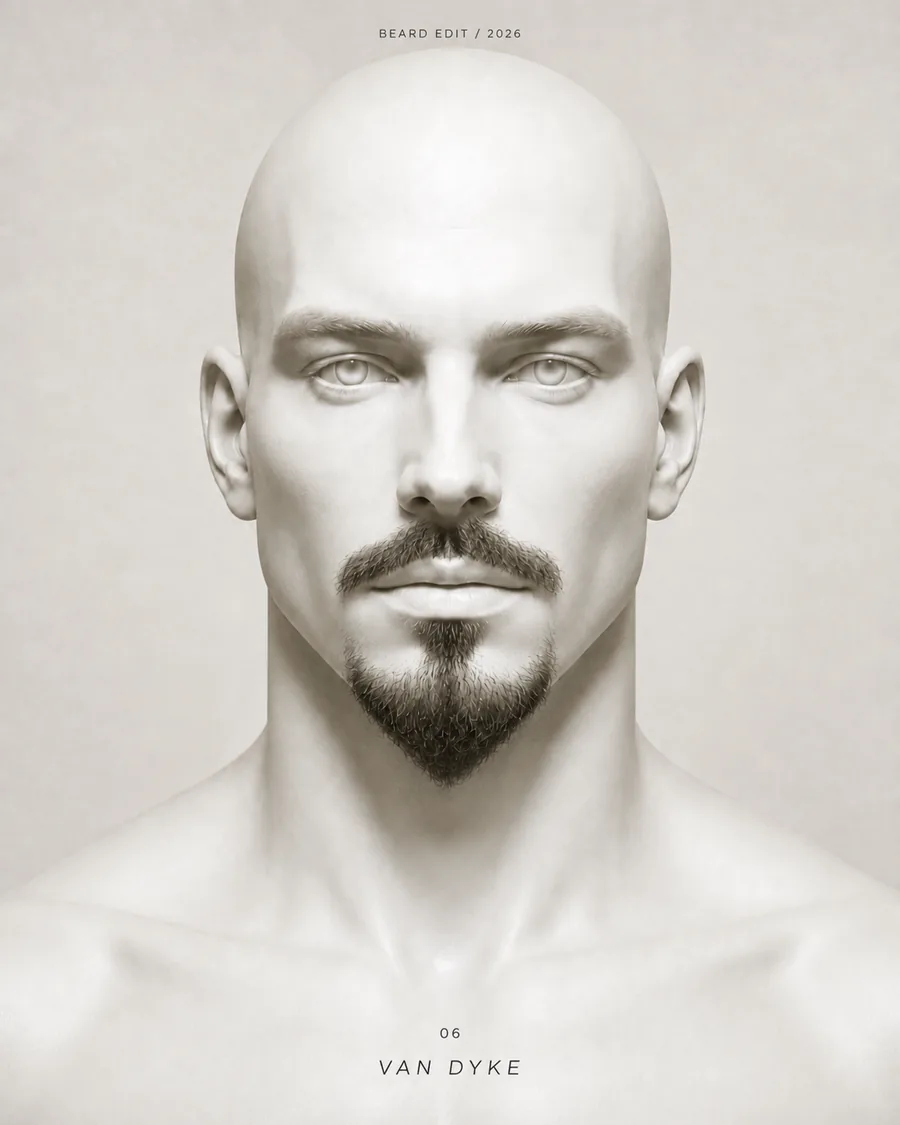
What the van dyke beard actually is
Named after a seventeenth-century Flemish painter who wore one, the Van Dyke is two disconnected pieces: a moustache, and a chin beard that comes to a point. Everything else is shaved — cheeks, jaw, and the corners of the mouth. There is no jaw strip, which is what distinguishes it from a Balbo. Because so little hair is left, every millimetre of what remains is visible, which is why it looks deliberate and why it is unforgiving of a shaky hand.
Who it suits
It works best on square and round faces: the point at the chin lengthens the face, and the bare jaw keeps the width down. On a long face it is a poor choice, adding length to length. The real reason to choose a Van Dyke is patchy growth. If your cheeks grow in islands and every full-beard attempt has looked unfinished, this style removes the problem entirely — the cheeks are supposed to be bare.
How to get it
- Grow the chin and moustache for four to six weeks. The cheeks can be shaved throughout; you are not waiting on them.
- Shave the cheeks and jaw completely with a razor, not a trimmer. Trimmer stubble on the cheeks blurs the whole effect.
- Shave the corners of the mouth so the moustache and chin beard are clearly separate.
- Shape the chin beard: narrow at the sides, running down to a point below the chin. Take small cuts and check straight-on often.
- Trim the moustache to the lip line and keep it roughly the same width as the chin beard, so the two pieces balance.
- Finish by shaving a clean line under the jaw — the neck should be entirely bare.
Keeping it
Every two or three days, because bare skin shows stubble fast and the contrast is the entire style. Use a razor for the cheeks rather than a trimmer. Keep a fixed reference for the width of the chin beard — a Van Dyke that creeps wider each week becomes a circle beard without you noticing.
What goes wrong
Letting the moustache merge with the chin beard is the failure that turns a Van Dyke into a circle beard. It takes about a week of not shaving the mouth corners. The other error is making the chin beard too wide: the style depends on it being narrow and pointed, and a wide chin block with bare cheeks looks like an unfinished beard rather than a chosen one.