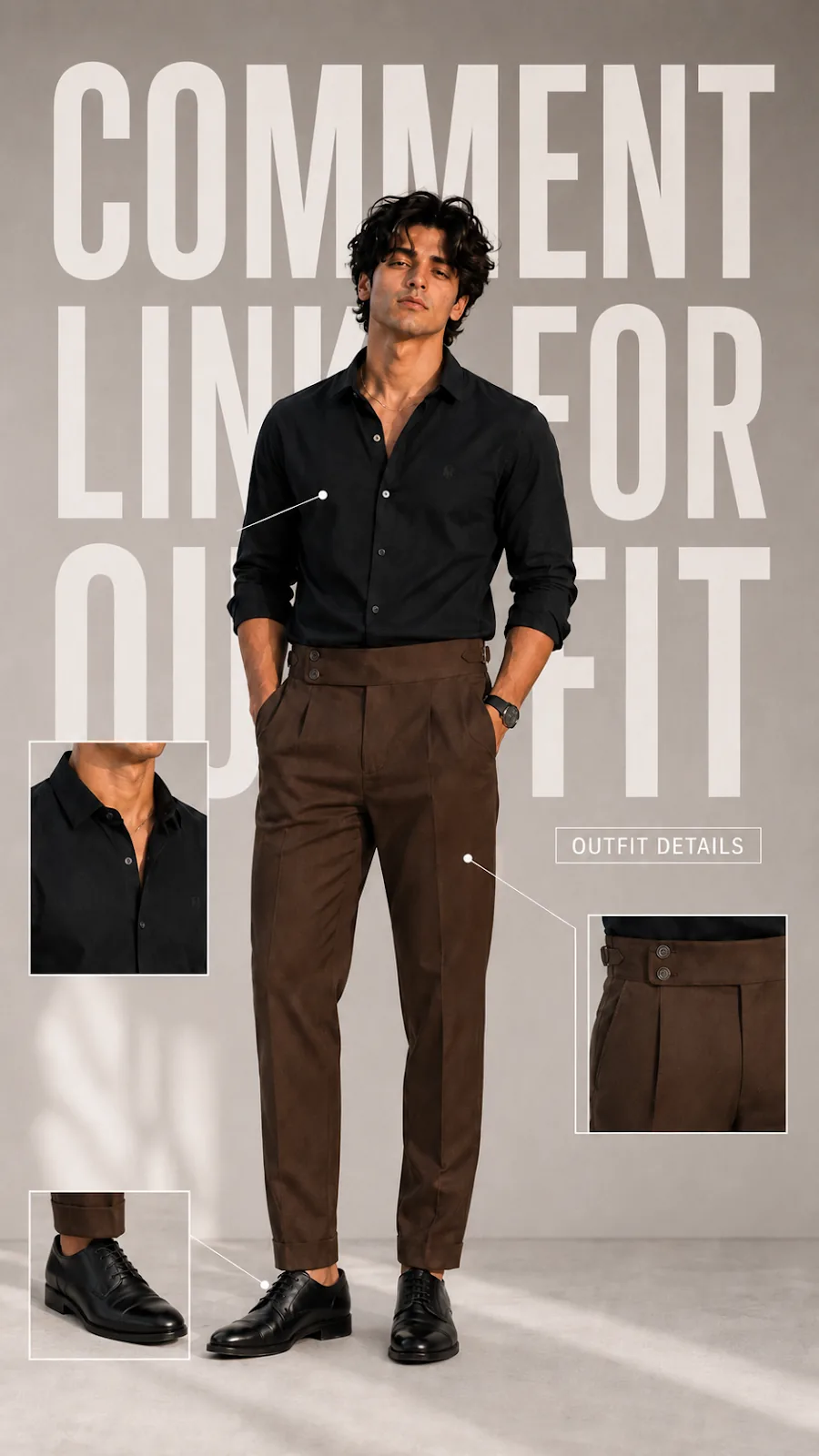


Why it works
You have probably heard the old rule: never wear black with brown. That rule is about light browns. Black next to tan or camel is a harsh, high-contrast clash — the two fight each other. But take the brown down to chocolate or coffee and everything changes: now you have two deep tones sitting close in darkness, one cool and one warm, and the effect is depth instead of contrast. It is the same logic as black with navy — supposedly forbidden, actually one of the best-kept combinations in menswear.
The formality comes from the structure. Every piece here is tailored: a fitted shirt tucked into a high, clean waist, a pressed trouser with a pleat, a polished leather shoe. There is not a single casual element to dilute it, which is why this outfit photographs like money without a blazer anywhere in sight.
And black frames brown beautifully. Shirt at the top, shoes at the bottom — the brown trousers sit inside a black border. That framing is what makes the outfit look designed rather than assembled.
The exact shades
This combination lives or dies on the brown:
- Pants — chocolate, coffee or dark walnut. The test: your brown should be closer in darkness to the black shirt than to your skin. Mid-browns work in soft evening light; tan, khaki and camel do not work at all with a black shirt. When in doubt, go darker.
- Shirt — true matte black, not faded. A black shirt that has washed out to charcoal-grey undoes the whole effect. Matte cotton beats anything shiny; a sheen turns this from formal dinner to nightclub. If your black shirt is old, this is the outfit that will expose it.
- Shoes — polished black leather only. Cap-toe oxfords are the top of the range for this; black derbies or a black loafer dress it down a notch. Brown shoes are the common error — unless they are clearly darker than the trousers they merge into them, and the black frame collapses.
Shirt, shoes & watch
The shirt: tucked, always — this is the formal member of the black-shirt family. Top button open for dinners, closed for events. Fit matters more than usual because a tucked shirt shows its cut: slim through the body, no ballooning at the waist. Sleeves down for full formal, one deliberate roll for evening-relaxed.
The trousers: if they are Gurkha-style with side adjusters, wear them beltless — that clean, uninterrupted waistband is the detail people notice without knowing why. If your trousers have belt loops, the belt must be black to match the shoes. A brown belt with black shoes is the one mistake that breaks this outfit instantly. Let the hem sit at a slight break or a clean cuff over the shoe.
The extras: one minimal watch — black dial, black leather or dark steel. Skip brown straps; they almost never match the exact brown of the trousers, and a near-miss reads as an accident. No chains, no bracelets, nothing else. The restraint is the style.
When to wear it
This is an evening-first formal outfit:
- Perfect for: dinner dates, evening events, office parties, cocktail-adjacent functions, client dinners, birthdays where you want to look sharp without a blazer.
- Works for: most Indian offices as confident business wear, and smart-casual venues where you swap the oxfords for black loafers.
- Avoid for: interviews and very conservative offices — a light shirt is the safer read there — and long daytime summer exposure, where a black shirt genuinely runs hot. For weddings, this works for evening receptions but cedes to festive wear for ceremonies.
Season-wise, it is at its best from monsoon through winter. In peak summer, keep it for after sundown — which is when it looks best anyway.