← AI prompts · Poster
Mirror selfie with cartoon stickers — chibi AI prompt
A cute social poster — one real mirror-selfie surrounded by four chibi cartoon sticker versions of you, with doodles and handwritten words. The hard part is that all five figures have to be the same person, in two completely different rendering styles. Copy the free prompt below.
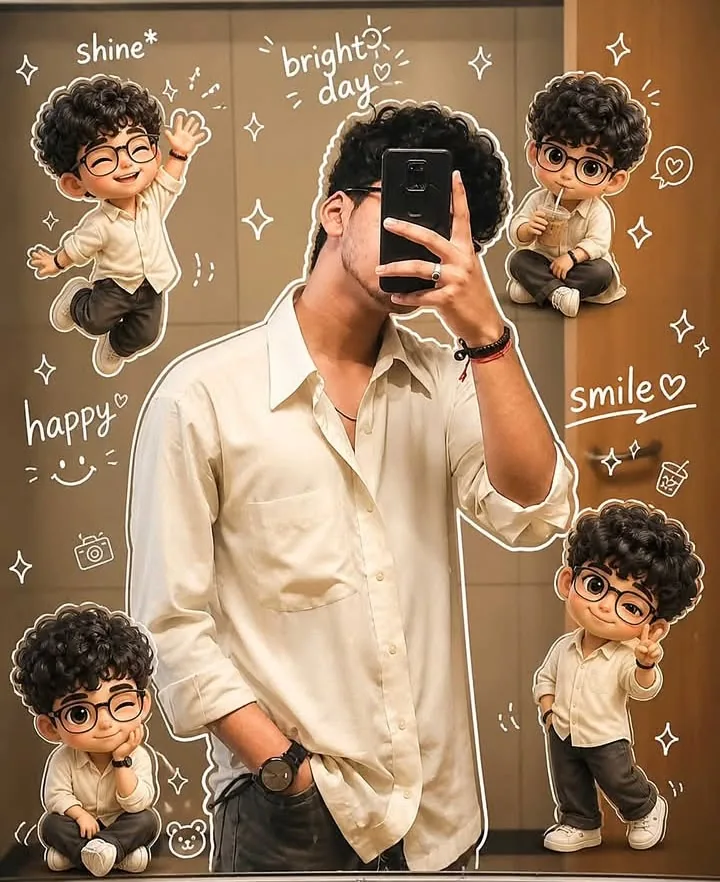
The one line that decides this: the uploaded photos are the only source of facial identity for both the real person and the surrounding cartoon versions — which is what stops the four stickers coming back as cute strangers standing around your photo.
About this prompt
Almost every other prompt on this site asks a model to do one thing well. This one asks for two incompatible things in one frame: a photographic mirror selfie of you, and four glossy 3D cartoon miniatures that also have to be you. The cream shirt, the flat light and the white outlines all exist to let those two layers share a picture.
The line doing the most work is the first one: the uploaded photos are the only source of facial identity for both the real person and the surrounding cartoon versions. Without it you are running two unrelated jobs — an identity-preserving portrait, and four generic cute characters — with nothing tying them together.
The lighting is deliberately boring: warm indoor light from above and in front, soft shadows, no harsh contrast. A chibi sticker is flatly lit by nature, and a hard-lit photoreal figure beside four flat cartoons reads as two images stuck together. Thin white doodles need that even range too — they have nowhere to sit in a blown highlight or a black shadow.
The wardrobe is a value decision, not a fashion one. The shirt is off-white to cream, the room is beige and tan, and the palette paragraph says the white doodles and outlines provide the contrast. Everything sits one notch below white so pure white is left for the line work. A true white shirt spends the brightest value in the picture on the very surface the figure's own outline has to separate from.
The composition is built around the corners. The subject sits slightly lower than mid-height so the top two stickers get headroom, and each is enumerated separately, corner and pose named, because AI image tools have a well-known habit of losing count when asked for a set number of repeated objects. Other clauses point at "the reference" — a ring if shown in the reference, doodles in the same general arrangement as the reference — because this was written to sit beside a layout image. With face photos alone the layout rests entirely on the explicit lines: 4:5, centred figure, four named corners, the doodle word list.
How to use it
- Tap Copy prompt above.
- Open a tool that takes reference photos — Gemini, Nano Banana, ChatGPT in image mode, Midjourney with a character reference, Leonardo.
- Attach two to four sharp photos: one showing your jaw, mouth and facial hair clearly, one front-on shot showing your hairline and hair volume.
- Add the layout reference image too if you have one, then generate at 4:5.
Why these lines are in the prompt
most of the face should be obscured by the smartphone — with the visible lower half of the face should preserve the user's identity, this halves the identity problem. Eyes and nose are where a face stops being yours; the phone removes them and leaves recognition to the jaw, mouth and facial hair.
the left hand tucked casually into the trouser pocket — one hand deleted from the drawing job. The other is already wrapped around a phone in front of a face, the most demanding anatomy in the picture.
a clean white sticker-like outline around the body, and then add a thin soft outline around the main realistic figure — the same device on both layers, so the photograph is treated as a sticker too and the poster reads as one designed object rather than cartoons dropped onto a photo.
all cartoon characters should wear a simplified version of the same outfit as the main subject — the outfit is the second identity signal, and the one that survives simplification. When a chibi head cannot carry recognition alone, five figures in the same cream shirt still read as one person.
simple and blurred enough not to distract — the background carries four stickers, a scatter of doodles and four handwritten words on top of it. Put texture underneath and the white line work stops being readable.
The three ways this goes wrong
The phone slides off your face. You get a fully visible face with a phone floating near it. The prompt's negative list names this twice — phone not covering face and face fully visible when it should be partially covered — a fair sign of how fragile it is. Negatives are weak medicine here, so state the boundary positively: "The phone must cover the face from the eyebrow line down to just above the upper lip. Only the mouth, jaw and chin remain visible."
The handwritten words come out wrong. Four separate strings, one pairing a word with a heart glyph, and AI image tools have a well-known habit of mangling text. Ask for less: "Write one handwritten white word, shine, in the upper-left area. Do not place any other text anywhere in the image." If a stray asterisk turns up rendered into the poster, that is the list punctuation being picked up as text — rewrite those lines as a plain sentence.
The four stickers are cute strangers. Adorable, consistent with each other, and not you — and the poster only means anything if the cartoons are recognisable. After the numbered corner list, add: "Each chibi must keep the same hairline shape, hair volume and texture, eyebrow shape, skin tone and facial-hair pattern as the uploaded photos. Simplify the features, do not replace them."
Making it yours
- Your name in the handwriting. Replace the four doodle words with one: "Write one handwritten white word, my name Rohit, near the upper-left." A single short string is the version most likely to come back spelled right.
- A different wardrobe. Swap the shirt paragraph for what you actually wear — "a charcoal oversized t-shirt with light-wash jeans". Going dark, add "keep the white outline thin"; going light, stay off-white so the outline still separates.
- A different mirror. A gym mirror, a lift lobby, a tailor's fitting room. Keep both conditions — simple, and blurred — and keep the warm tones the doodles depend on.
- Two stickers instead of four. Cut the numbered list to two on opposite corners, top-left and bottom-right. Diagonal placement holds the frame together; two on one side tips it.
- 4:5 to 9:16 for a story. It works, but the corners pull away from the figure and the stickers look like they are drifting rather than orbiting it. Re-specify them as a pair above the head and a pair beside the hips.
- Uncover the face. Delete the phone-obscuring lines and hold the phone at chest height. You get a full face, and take back the hardest part of the job: your real face now has to be right as well as four cartoon versions of it.
If the typography half interests you more, the Ganpati invitation card prompt renders words inside the image too — a date, a time and a venue set at display size rather than handwritten.
Then match the pose with your camera using the Pose Mirror, sharpen your beard styling, get the shoes for the look, or browse more AI photo prompts.
Frequently asked questions.
How many photos should I upload, and what should be in them?
Do I need to set identity strength or transformation strength?
I wear glasses — will they survive the cartoon versions?
Can I use this as a profile picture?
Why do the watch and bracelets end up on the wrong wrists?
Is this prompt free, and what do I need to run it?
Pair it with
Get the mirror-selfie pose right on camera.
Got the look? Match the pose with your camera.