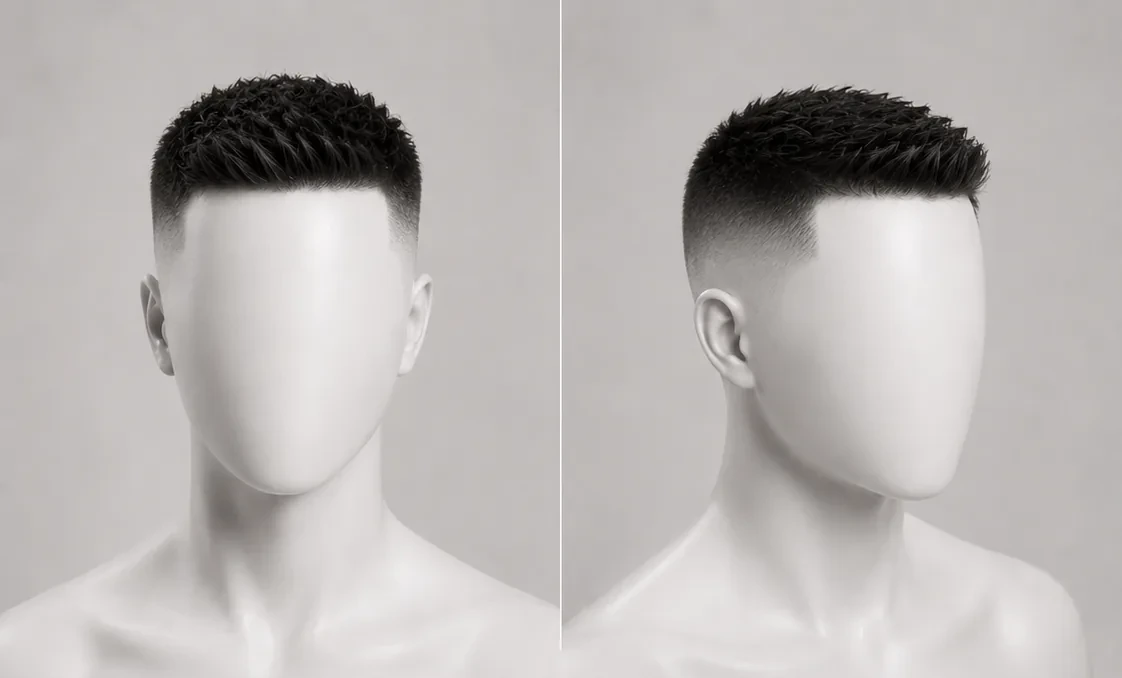
Who it suits
Round and square faces both work, but for different reasons.
A round face gets slimmer because the sides are taken almost to nothing. Removing that width at the widest point of your head is the single most effective thing you can do for a round face. The short top is not adding height, but the contrast is doing the work.
A square face suits it because the cut has hard, straight lines, and those lines rhyme with a strong jaw. Nothing is softened, and nothing needs to be.
Straight and thick hair looks best. Coarse Indian hair stands neatly at short length, which is exactly what this cut needs. Wavy hair works once it is short enough that the wave disappears.
Avoid it if your head has dents, scars or an unusual shape, because there is no hair left to hide anything. Also avoid it if your hairline is receding, since the cut puts the entire hairline on display.
How to ask your barber
Say: "High and tight. Sides and back on a number 0 or skin, faded high, above the temple. Leave the top at a number 3 or 4, about 1.5 to 2 cm."
The fade is high by definition. That is what the word high means in the name. If you want it softer, you are asking for a different cut.
Decide whether you want the sides at skin or at a number 0.5. Skin is sharper but needs more upkeep.
Ask for a clean, squared neckline if you want it strict, or a natural taper if you want it a bit softer.
Do not ask for texture on top. There is not enough length for texture to mean anything.
How to style it
- Towel-dry. That is most of the job done.
- If your hair is very short, no product is needed at all.
- If you left the top at a number 4, rub a small amount of matte clay between your palms.
- Push it forward or straight up with your fingertips. There is no combing here.
- Done. No blow-dryer.
This is the lowest-effort cut on this list to style and the highest to maintain. That trade is the deal.
Maintenance
Trim every 2 weeks. The whole cut is contrast, and contrast dies fast. At 3 weeks the sides have grown into the top and it just looks like an ordinary short haircut.
It does not grow out gracefully. There is no in-between stage that looks intentional.
Daily effort is under a minute. It is also the best cut for Indian summers, because there is almost no hair to trap heat or sweat.
Variations
High and tight with a burst fade. The fade arcs around the ear rather than running level. Slightly less severe.
Induction cut. Everything, including the top, goes to one very short guard. Even simpler.
High and tight recon. The sides go to skin and only a small island of hair is left at the front of the crown. Extreme.