The short version: pick a scene below, tap Copy prompt, and paste it into ChatGPT, Google Gemini or Nano Banana together with one sharp photo of yourself. Every copy carries the scene prompt plus the identity rule that tells the tool to keep your face yours. All ten are free.
The ChatGPT 80s photo trend took off on Indian Instagram this week. On 10 September India TV listed seven retro looks to try, from a Bollywood-heroine portrait and a family album to a wedding, a college look and a street snapshot. None takes you out to a hill road or a railway platform, and none says what a man should wear.
This series adds settings those looks leave out: ten places an Indian family album might have visited between 1974 and 1988. Each prompt names its year, its setting, its light and its film, and each carries a list of modern objects that would give the year away. None asks you to describe your clothes. Every prompt tells the model to choose period clothing that suits the person in the photo, and every clothing list includes menswear — quoted in each section below — so the model has a man's wardrobe to pick from when a man uploads his photo.
Five of the ten scenes have an example image, all made with an AI prompt and all showing the same young woman, which makes the change in clothes and light easy to compare.
The rule all ten prompts share
One identity paragraph sits under all ten scenes. The Copy buttons further down add it automatically; this button copies it on its own, for a prompt of your own.
The identity rule
Identity fidelity is the highest priority. The uploaded person must remain unmistakably the same individual. Preserve facial geometry, skin tone, age, natural asymmetry, body proportions, and recognizable appearance. Automatically adapt the period clothing, hairstyle, accessories, and styling to the person in the reference image without requiring the user to specify gender or clothing. Do not create generic-model features, facial slimming, skin whitening, de-aging, artificial makeup, plastic skin, modern beauty filters, modern cinematic HDR, AI-looking textures, or modern objects.
Each scene prompt spends most of its words on clothes, props and film, and AI image tools have a well-known habit of letting identity drift in when a prompt is that busy: a slimmer jaw, a straighter nose, a face that belongs to a stock model rather than to you. They also have a well-known habit of lightening skin and smoothing age away when asked to make a picture look like an old photograph, which is why the rule names skin whitening, de-aging and plastic skin one by one instead of trusting a general request to keep your face. It also carries the one instruction the scenes depend on: choose the clothes for the person in the photo, so nobody has to state whether they are a man or a woman.
The ten scenes, 1974 to 1988
They run in date order, and the light changes as the years pass: soft daylight in the seventies, a little fill flash from 1982, and direct flash in most of the later scenes.
1974 · Garden picnic
Shade trees, a woven basket, soft afternoon sun and a slight lens flare.
See the prompt ↓
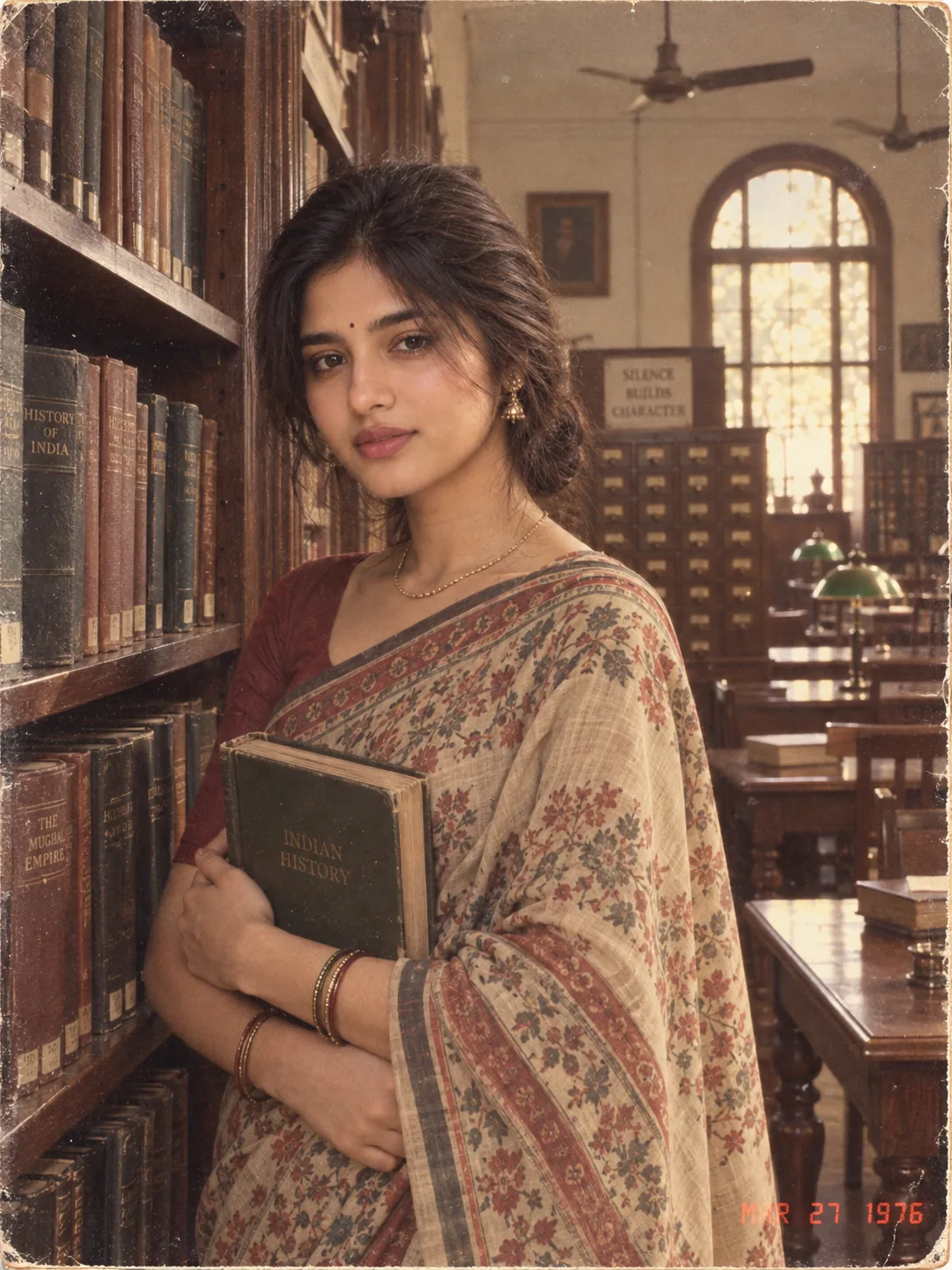
1976 · Heritage library
Tall shelves, card catalogues and warm window light.
See the prompt ↓
1978 · Vintage car
Half body, leaning on a chrome-trimmed sedan in warm afternoon film.
See the prompt ↓
1982 · Temple courtyard
Carved pillars, brass lamps and a family-album finish.
See the prompt ↓1983 · Classic motorcycle
A quiet country road, dry grass, stone walls and a touch of flash.
See the prompt ↓1984 · Railway platform
A candid compact-camera snapshot beside an old painted coach.
See the prompt ↓
1985 · Mountain road
Full length on a winding hill road, pine trees and mist behind.
See the prompt ↓
1986 · Old cafe
Seated at a small table, flash mixed with warm bulbs.
See the prompt ↓1987 · Lakeside hill station
Evening flash against a blue-grey lake and misty hills.
See the prompt ↓1988 · City street
Taxis, old buses, analog signboards and direct on-camera flash.
See the prompt ↓1974 · Soft vintage daylight
1974 garden picnic
This is the earliest and softest scene in the series: daylight only, no flash, so colour does most of the dating. The prompt asks for warm faded yellows, muted greens, low saturation and mild highlight overexposure: the look of a print that sat in the sun on a sideboard for years. The props carry the rest — woven picnic baskets, patterned cloth and an old bungalow in the distance.
The detail most likely to go modern is the picnic itself. AI image tools have a well-known habit of filling a spread with whatever food looks like today, so check the cloth for printed packets, plastic bottles and moulded chairs. The prompt already bans modern picnic packaging, plastic furniture and contemporary bottles.
For a man, the prompt's own list offers flared trousers, patterned shirts, knitted tops and casual jackets, with an analog watch, sunglasses or vintage sandals, and hair as neat short hair or feathered layers with a centre or side parting.
Copy adds the identity rule to the end.
1976 · Classic portrait
1976 heritage library
A library is a rare setting where almost nothing has to be dated: wooden shelves, card catalogue drawers and ceiling fans looked the same for decades. What places this frame in 1976 is the treatment. The prompt asks for warm window light, low contrast, a slight vignette and muted browns and greens; the warm window light is easy to see in the portrait at the top of this page.
The detail most likely to go modern is the books. One glossy paperback with bright cover type is enough to break the year, which is why the prompt bans modern books with contemporary covers. Hardbound spines like History of India and The Mughal Empire in the example are what you want on the shelf behind you.
For a man, the prompt lists collared shirts, knit sweaters, flared trousers and classic jackets, with vintage spectacles, an analog watch, a notebook and a tidy short hairstyle.
Copy adds the identity rule to the end.
1978 · Half-body retro portrait
1978 vintage car
The car carries this scene, so the prompt keeps it in frame with a half-body pose: you lean on an old 1970s sedan with chrome bumpers, rounded mirrors and vintage headlights while the roadside blurs away. Warm afternoon light and slightly faded reds and greens do the dating. It is also the only prompt in the series that says not to alter your gender presentation, a useful guard when one outfit list holds both blouses and wide collars.
The detail most likely to go modern is the car. AI image tools have a well-known habit of blending eras on vehicles, so look hard at the headlights, the wheels and any dashboard visible through the window. The prompt names no make; if you want a particular Indian car, add it by name.
For a man, the list gives flared trousers, wide-collar shirts, fitted jackets and knitted tops, with a classic leather belt, vintage sunglasses and an analog wristwatch.
Copy adds the identity rule to the end.
1982 · Traditional full-length portrait
1982 temple courtyard
The early eighties arrive here as a change of light. This is the first prompt in the series to ask for fill flash, mild and mixed with warm sunlight, and the finish it names is an old family-album photograph. Carved pillars, weathered steps, brass lamps and bells set the place, and the example image shows a man in a white dhoti in the background, as a working temple courtyard would have.
The detail most likely to go modern is the ground around you. The prompt bans plastic barricades, modern tourists and modern shoes, so check the edges of the frame for crowd barriers and trainers. One judgement call: the accessory list includes traditional sandals, but footwear is normally left outside an Indian temple and the courtyard is walked barefoot, so it is worth deleting that item.
For a man, this is the most traditional list in the series: kurta-pajama, traditional shirt and trousers or dhoti-inspired attire, with an analog wristwatch, a simple bag and a scarf.
Copy adds the identity rule to the end.
1983 · Countryside adventure
1983 classic motorcycle
The brief is specific: a period-correct early-1980s motorcycle parked on a quiet countryside road, with old trees, dry grass, stone walls and distant hills. The film is rougher than in the seventies scenes — mixed daylight with subtle direct flash, mildly underexposed shadows and slight highlight bloom, the look of a roadside stop on a long ride.
The detail most likely to go modern is the machine. AI image tools have a well-known habit of reaching for a current bike shape, with angular fairings and graphic-covered helmets, and the prompt bans modern motorcycles and helmets with modern graphics for exactly that reason. A round headlamp, spoked wheels and a plain fuel tank are the cues to look for; modern road markings are banned too, so check the tarmac.
For a man, this is the most wearable list in the series: high-waisted jeans, straight trousers, patterned shirts, vintage jackets and sweaters, plus an analog wristwatch, vintage sunglasses, a leather bag, a belt and period footwear.
Copy adds the identity rule to the end.
1984 · Candid travel photograph
1984 railway platform
This is the most candid scene in the series, written as a spontaneous compact-camera snapshot with direct flash, a realistic colour cast from mixed daylight and station lighting, and minor motion blur in the background. That blur is part of the date. A posed, pin-sharp platform reads as a film set; a slightly careless frame with passengers smeared behind you reads as a real journey. An old painted coach, wooden benches, metal trunks, analog clocks and iron columns do the rest.
The detail most likely to go modern is the luggage. A rolling suitcase moves a platform into this decade at a glance, and the prompt bans rolling luggage, electronic railway boards and QR codes by name. Check the background passengers too; the prompt asks for them in 1980s clothing.
For a man, the list gives collared shirts, sweaters, high-waisted trousers and casual jackets, with an analog watch, a shoulder bag, a leather suitcase and vintage sunglasses.
Copy adds the identity rule to the end.
1985 · Full-body travel portrait
1985 mountain road
This is the longest prompt in the series and the strictest about your face: it already says not to beautify, de-age, reshape or lighten the skin before the identity rule is added. The scene is a family holiday in the hills — a winding road, misty hills, pine trees and stone roadside barriers. In the example those barriers are whitewashed, a stronger hill-station cue than the mountains themselves.
Full length matters here. The trousers and shoes are part of the date, so do not crop them away. The detail most likely to go modern is the road: watch for painted lane markings, reflective signboards or a new car on the bend. The prompt bans modern vehicles, contemporary signage and modern sneakers, and its banned-objects line is the one to keep if you edit anything else.
For a man, it lists high-waisted trousers, patterned shirts, denim or lightweight jackets and knitwear, with an analog watch, vintage sunglasses, a belt and classic footwear.
Copy adds the identity rule to the end.
1986 · Warm indoor portrait
1986 old cafe
Indoor flash is what dates this scene. The prompt asks for direct compact-camera flash mixed with warm indoor light, imperfect white balance and gentle red or yellow colour shifts — the slightly off colour of a snapshot taken under bulbs. The prompt's setting is a generic old Indian coffee house with wooden chairs, ceiling fans, patterned floor tiles and ceramic cups.
The example image leans further into the old-cafe look — a steel container on a marble-topped table and patrons in white shirts — even though the prompt lists Formica tables. Treat the prop list as a menu rather than a checklist. The detail most likely to go modern is the counter behind you, where an espresso machine or a lit menu board can creep in; the prompt bans modern coffee machines and LED menus.
It is a waist-up seated portrait, so the top half carries the look. For a man, the list gives structured shirts, sweaters, high-waisted trousers and light jackets, with a vintage watch and a leather belt.
Copy adds the identity rule to the end.
1987 · Evening flash portrait
1987 lakeside hill station
The only evening scene in the series, and the most specific about light: direct camera flash against dusky ambient light, giving a bright subject and a darker blue-grey background, with a subtle magenta shift and halation around the lamps. That gap between a flash-lit face and a dim lake is how a direct-flash photo after sunset looks, and it is the part to protect. The setting is a hill-station promenade with an old lakeside railing, small wooden boats, old street lamps and colonial-era buildings.
The detail most likely to go modern is the light itself. AI image tools have a well-known habit of evening out a dark background into a bright, glossy scene — exactly the modern cinematic HDR the identity rule forbids. If the lake comes back as bright as your face, regenerate. The prompt also bans modern boats and LED lamps.
For a man, the list gives layered shirts, sweaters, cropped jackets, cardigans, high-waisted trousers, denim and scarves, with an analog wristwatch, a leather belt and classic footwear.
Copy adds the identity rule to the end.
1988 · Bold urban fashion
1988 city street
The last year in the series is the loudest, and the prompt says so: bold but tasteful late-1980s fashion, slightly saturated reds and subtle cyan shadows under direct on-camera flash. The street does much of the dating — taxis, Ambassador-style cars, old buses, concrete buildings, faded storefronts, analog signboards and parked bicycles. It is the only prompt in the series that names a car, and even then only as a style.
The detail most likely to go modern is the lettering. AI image tools have a well-known habit of filling a busy street with near-letters and familiar-looking logos, and one current brand mark breaks 1988. The prompt bans contemporary brand logos, LED billboards and digital signage. Garbled old signboards can pass; a legible modern logo cannot.
For a man, this is the sharpest list: structured jackets, shoulder-detail shirts, high-waisted trousers, denim, sweaters and belts, with an analog watch, sunglasses and vintage shoes. One bold piece reads as 1988; three read as costume.
Copy adds the identity rule to the end.
What goes into a ChatGPT 80s prompt
All ten prompts are built from the same six parts, so if you want to adapt one or write your own ChatGPT 80s prompt, these are the parts to keep.
- Your photo as the identity reference. Each prompt opens by naming your uploaded photo as the reference, and its next paragraph lists the features to keep, before the clothes, the light and the film are described.
- One exact year and one place. 1985 on a scenic Indian mountain road gives the model a single target; the 80s leaves it a whole decade to choose from.
- Clothes chosen for the person. None of the ten describes your outfit. Each asks the model to pick period clothing that suits whoever is in the photo, from a list that includes both menswear and womenswear.
- Period light and film. Grain, faded colour, daylight or flash, and print texture do much of the dating. Without them, period clothes look like a costume shot on a new phone.
- A date stamp. The red-orange stamp in the corner is the trend's signature, and one of the details most likely to come back garbled; the fix is in the mistakes below.
- A banned list. Near the end, each prompt names the modern objects that would give the year away, such as smartphones, LED lights and modern cars.
How to use a ChatGPT 80s prompt
The same six steps work for every scene, in ChatGPT, Google Gemini or Nano Banana.
- Choose one scene. Pick the year and place you want and tap its Copy prompt button. The copy holds the scene prompt and then the identity rule.
- Upload one sharp, evenly lit photo. Front-facing, with no filter, sunglasses or cap, and your face clear and in focus. A head-and-shoulders photo works for the half-body scenes; for the full-length ones, a photo that also shows your build gives the tool your body proportions to work from.
- Paste the prompt with the photo. Start a new chat, attach the photo and paste the prompt in the same message, so the tool reads both together.
- Generate at the tallest vertical option your tool offers. The full-length scenes, such as the temple, the mountain road and the city street, need room for trousers and shoes, and a square frame leaves little space below the waist.
- Check the face before anything else. Put the result next to your photo and compare the jaw, nose, skin tone and age. Then read the date stamp, then look at the clothes and the background.
- Regenerate rather than edit when the face drifts. AI image tools have a well-known habit of drifting further from your face with each follow-up edit, so start a fresh chat with the same photo and prompt instead of asking for corrections in the same thread.
Mistakes all ten share
Ten different scenes can fail in the same four ways. Here is what each looks like and the line that fixes it.
A garbled or missing date stamp
Every prompt asks for a red-orange date stamp with a year and nothing more, which leaves the model to invent the day and the month. AI image tools have a well-known habit of garbling text they have to make up, so a stamp can come back as near-digits, or not at all. The fix is to give it the exact string. The example images show the pattern: APR 14 1985 on the mountain road, MAR 27 1976 in the library, AUG 15 1982 in the temple. Replace the stamp line with, for example, Add a small red-orange date stamp in the lower right corner reading exactly APR 14 1985. The car example uses the other common film-camera style, '78 11 26, year first; either works, but pick one and spell it out. Keep the stamp's year the same as the scene's year, or the stamp contradicts the clothes. If it still smears after two attempts, add the stamp in a photo editor.
Costume or parody styling
Period prompts invite parody: a wig-like hairdo, oversized collars on everything, disco colours, a pose lifted from a film poster. These prompts guard against it with words like tasteful, natural and historically believable, and the rule tells the model to adapt the styling to the person. When a result still looks like a theme party, the likeliest cause is too many period signals at once, so name fewer things rather than more. For a man, one period piece with plain basics reads truer than four: flared trousers with a plain shirt, or a wide collar with straight trousers. Pleated, high-waisted trousers are still cut today, and our black shirt and brown trousers guide explains why a high or pleated waist makes a tuck look sharper. If you need a line, add Everyday clothing an ordinary person wore in that year, not a costume or a parody. The same goes for hair: a neat side parting with some volume convinces more than a big, set shape.
Skin whitening or de-aging
This is the failure the identity rule was written for. Old-photo prompts ask for creamy skin tones, soft focus and faded colour, and AI image tools have a well-known habit of reading those words as permission to lighten skin, smooth texture and take years off a face. The rule names each one: no skin whitening, no de-aging, no facial slimming, no plastic skin, no modern beauty filters. Check the result next to your photo on a bright screen, and compare the neck and hands with the face as well; a mismatch between them is an easy tell. If your skin has come back a shade lighter or your laugh lines have gone, do not ask for a fix in the same chat. Start again with a sharper photo and add Keep my skin tone exactly as in the photo, including its depth and texture.
A modern object creeping in
Every prompt closes with a banned list, and each list is written for its scene: rolling luggage on the 1984 platform, plastic barricades in the 1982 temple, LED menus in the 1986 cafe, helmets with modern graphics on the 1983 road. The objects to watch for are the ones the model adds on its own: a phone in a hand or a shirt pocket, a white sneaker, a clear plastic water bottle, a car with slim modern headlights parked far behind you. Look at hands, feet and the far background before you post, since those are the places nobody studies while waiting for a result. The wristwatch is the sneakiest case. Nine of the ten scenes ask for an analog watch, and the cafe asks for a vintage one, so a squared-off smartwatch face is an instant tell. If one object slips through, add it by name to that prompt's banned list and regenerate.