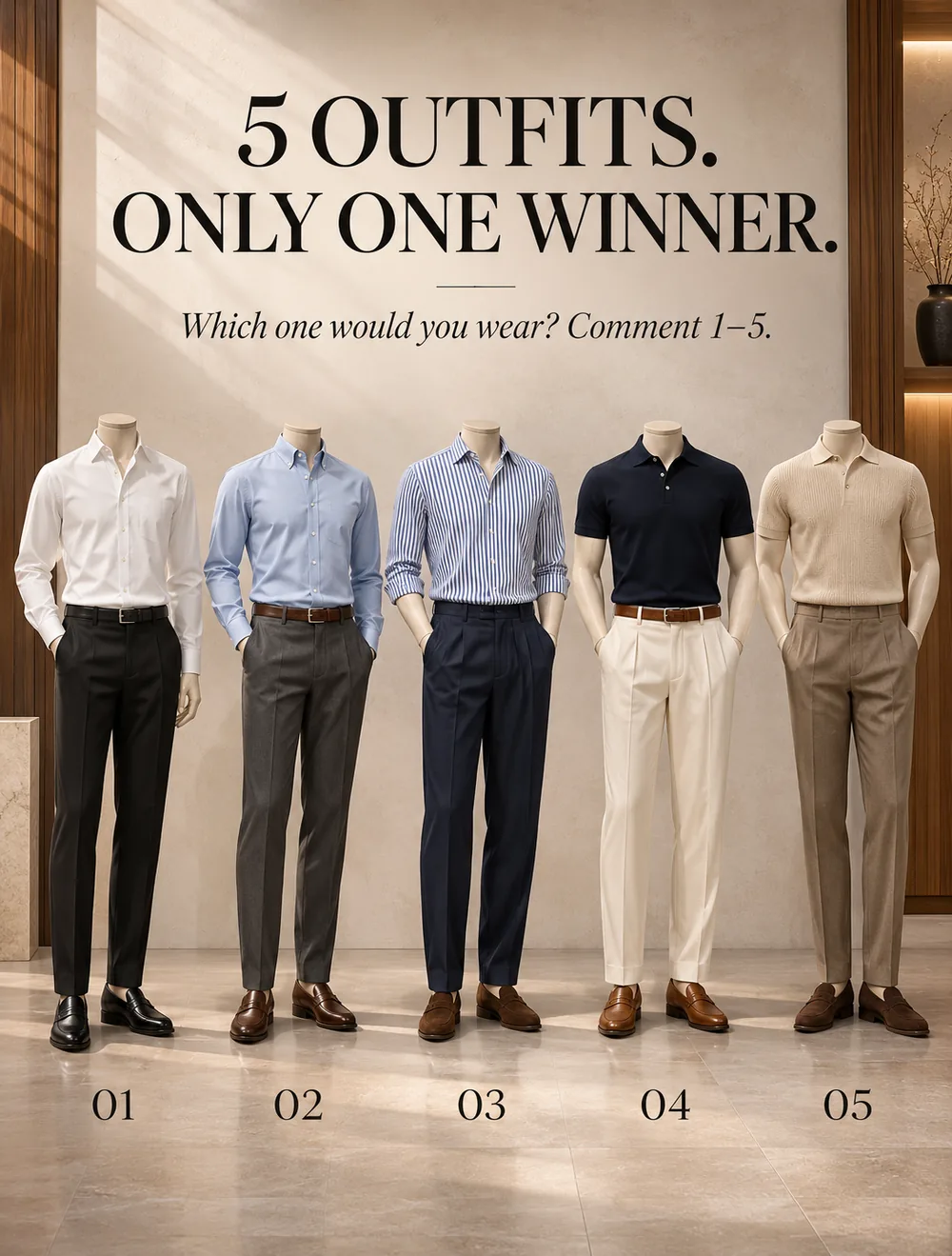
This started as an Instagram post asking which outfit you would pick, and the comments split roughly
how you would expect: the white shirt and the navy polo took most of the votes. Both are defensible.
Neither is the right answer.
Ranking clothes is only useful if you say what you are ranking them on, so here is the standard
before the verdicts.
FifthOutfit 01
White shirt, black trousers, black loafers
This is the most-worn combination in India and the least interesting thing you can do with a white shirt. It is the uniform: bank counters, hotel front desks, school prize days, the catering staff at the wedding you are attending. Nothing about it is wrong, which is why so many men wear it. It is simply invisible, and invisible is a worse outcome than slightly wrong.
There is a structural problem underneath the familiarity. White above and black below is the hardest light-to-dark break you can put at your waist, and a hard break there cuts your body into two visible halves. If you are under about 5′8″ that costs you height you did not have to give away. Black leather shoes make it narrower still — they work with black, charcoal and navy, and fight everything else in your cupboard.
Keep the shirt. Change the trousers to charcoal and the shoes to brown and you have built outfit 02, which is the one that wins.
FourthOutfit 03
Striped shirt, navy pleated trousers, brown suede loafers
The trousers and shoes here are excellent. Navy against mid-brown suede is one of the quietly great pairings in menswear, and pleated navy trousers hang better than flat-front ones on most builds. The shirt is what drops it to fourth.
A bold stripe is a memorable shirt, and memorable is the opposite of what you want from something you intend to wear weekly. People register a striped shirt and they register when it comes back. Rolled sleeves, pleats, a stripe and suede is four decisions arriving at once, and the outfit ends up louder than the man in it.
Own one striped shirt, wear it once a fortnight, and let the plain ones do the heavy lifting.
ThirdOutfit 05
Oatmeal knit polo, taupe trousers, brown suede loafers
The best-looking outfit of the five and the one with the narrowest use. Tonal dressing — beige on taupe, nothing contrasting — only works when something else creates separation, and here it is the ribbing in the knit. Texture is doing the job that colour has been told not to do. The same outfit in flat cotton reads as very expensive pyjamas.
Three honest caveats for India. A knit polo good enough to carry this is not cheap, and knitwear is warm in a country that is warm for most of the year. Stone trousers show everything. And beige sits close to the value of most Indian skin, so a full beige column leaves nothing framing your face — if you wear this, the knit needs to be clearly lighter or darker than your skin, not the same. Colour matching by skin tone covers where that line falls.
Brilliant for a dinner or a weekend. Not the outfit you build a wardrobe on.
SecondOutfit 04
Navy polo, cream pleated trousers, tan loafers
The best warm-weather outfit here, and in a country with eight months of heat that counts for more than it would in London. Navy at the top anchors your face, cream below keeps the whole thing light, and the break at the waist is softer than outfit 01 despite being almost as strong, because navy is a colour rather than an absence of one.
The polo is doing more work than it looks. A collar that stands up on its own, no logo on the chest, and a sleeve that ends mid-bicep rather than at the elbow is the difference between a polo that reads as deliberate and one that reads as a freebie from a corporate event.
It is second rather than first because cream trousers are a commitment. Cheap ones go translucent in direct sun, and they record every meal you eat and every scooter seat you sit on. Buy them in a heavier weight or do not buy them.
The winnerOutfit 02
Light blue shirt, grey flannel trousers, brown loafers
The winner, and it is not close. This outfit does the most jobs for the least thought, which is the only thing worth optimising for if you get dressed in a hurry.
Blue and grey is the most reliable pairing in menswear for a reason that is worth understanding rather than memorising. The two are close in temperature and far apart in brightness, so you get separation between top and bottom without the hard line that outfit 01 draws at the waist. Your eye reads one person, not two halves.
The details hold up individually too. A button-down collar keeps its shape without a tie, which matters because most men reading this will never wear one. Grey flannel is forgiving in a way that polyester formal trousers are not — it drapes instead of clinging. And brown shoes against grey trousers is, genuinely, the single highest-value swap most Indian men can make to what they already own.
Most of all it moves. Office, a client meeting, dinner, a daytime wedding function: same outfit, no changes, correct in all four rooms. That is what smart casual is supposed to buy you.
What all five already get right
Strip the colour out of these five and they become the same outfit, because the things that make
them look expensive are not colour decisions at all. Every one of them has trousers that reach the
shoe and stop, with one soft fold and no pooling over the laces. Every shirt is tucked. Every collar
sits on the neck rather than floating away from it. Every belt matches the shoe it is worn with.
There is not a logo anywhere in the frame.
That is the uncomfortable part. You can buy the exact colours in outfit 02 and still look nothing
like it, because what you are actually seeing is fit. A ₹900 shirt that fits beats a ₹3,000 shirt
that does not, and it is not close. The fit rules covers the four
measurements that decide it — shoulder seam, sleeve, trouser break and rise — and the shoulder is the
one to check before you buy anything, because it is the hardest thing to alter afterwards.
If your build is the reason nothing sits right, dressing for your
build is the more useful page of the two.
So what do you actually buy
In order, if you are starting from a cupboard of white shirts and black trousers:
One pair of brown leather shoes. This single purchase changes more outfits than anything else on
the list, because it unlocks the grey, navy, beige and olive trousers you already own but never wear.
Then grey trousers, which do more work than black ever will. Then a light blue shirt — the
formal shirt picks cover what to look for in the fabric, and the
same shirt works under a blazer or on its own with the sleeves rolled.
That is outfit 02, assembled in three purchases, and it is the only outfit here you could wear
twice a week without anyone noticing. Which colours go with which is set out properly in
shirt and trouser colour combinations, and if you are
unsure how formal any of this reads in an Indian office or at a wedding,
dress codes draws the lines.
One more outfit worth stealing from the same family: a
black shirt with brown trousers inverts the contrast rule deliberately and gets away with it.
A note on outfit 01, since it will come up
Saying the white shirt comes last is not saying it is bad. It is saying that correct and
forgettable is a poor trade when the fix costs one pair of shoes. If your office genuinely requires
black trousers, keep them and change the shoes to dark brown — you lose nothing and the outfit stops
looking issued to you.